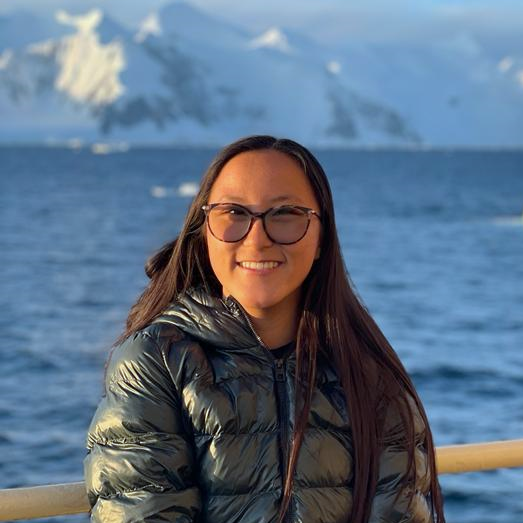
About Miah
Miah Manning (she/her) is a Ph.D. candidate in Biological Oceanography in the Massachusetts Institute of Technology (MIT) - Woods Hole Oceanographic Institution (WHOI) Joint Program in Oceanography and Applied Ocean Science and Engineering. Miah’s research combines wet lab and computational techniques, focusing on marine phytoplankton ecology. She is advised by Dr. Harriet Alexander.
Marine Microbial Ecology
“Appreciate the little things in life”
Whether that be a fresh summer breeze or the millions of microorganisms in a single milliliter of seawater, Miah urges you to take a moment to appreciate the small stuff! A common factoid among marine microbiologists is that 50% of the net global annual primary production is done by marine microbes. They are critical for the global cycling of important elements such as carbon, nitrogen, and sulfur. On a more granular scale, microbes play important roles in bottom-up controlled marine ecosystems where highr trophic levels are dependent on the robustness of the microbial primary producers to thrive. At even finer scales, microbes interact with each other by exchanging metabolites, predation, endosymbiosis, allelopathy, and more. Assessing the complex ecological roles of marine microbes allows us to understand their large impact on marine ecosystems.
Phytoplankton in a Changing Ocean
From the warm, coastal shores of the Gulf of Mexico to the icy, choppy waters of Antarctica phytoplankton thrive. Miah believes that one of the most amazing traits of microbial life is its phenotypic and genetic diversity. Over time, this allows phytoplankton and other microbes to adapt and survive in the most extreme environments on Earth. Some questions driving Miah’s research are, “What are the limits of this adapability?” and “How will climate change and anthropogenic stressors impact phytoplankton diversity, ecological function, and global biogeochemical cycling?”